
Search engines were originally built to reward websites that naturally earned trust, authority, and visibility across the internet. But as online competition became more intense, businesses started realizing that waiting for authority to grow organically could take years, especially in aggressive industries where visibility moves fast. That pressure gradually created demand for systems that could speed up authority building instead of relying only on slow natural recognition. Over time, that shift is what helped with the question: what is PBN links evolve from a small SEO tactic into a much larger authority-driven ecosystem.
The reason conversations around PBN links still continue today is because modern search rankings are still heavily influenced by external trust signals. In competitive search environments, strong content alone is often not enough to guarantee visibility anymore. Search engines still depend on authority patterns to decide which websites deserve attention first, and wherever authority shapes rankings, strategies designed to influence those signals will continue appearing naturally.
Before You Ask What Is PBN Links Ask Why Search Engines Made Them Necessary
Most people try to understand what is PBN links are without first understanding why the demand for them became so large in the first place. The bigger picture usually starts with how search engines evaluate authority online. Visibility has always been influenced heavily by external trust signals, which meant websites with stronger backlink profiles often gained attention much faster, even when newer websites were producing equally valuable content.
That imbalance quietly changed how businesses approached SEO over time. Instead of waiting years for recognition to develop naturally, many started looking for ways to strengthen authority more strategically in order to compete inside increasingly aggressive search environments.
- Search rankings still depend heavily on external authority signals
- Strong backlink structures often accelerate visibility faster than content alone
And that’s ultimately why PBN systems continued evolving. They were not created randomly, they emerged as a response to a ranking environment where authority itself became one of the biggest barriers to online visibility.
How Google’s own ranking logic created the gap that PBNs were built to fill
Search engines have always relied heavily on authority signals to decide which websites deserve visibility first. In theory, that system helps surface trusted and valuable content, but in highly competitive industries it also creates a major challenge for newer websites trying to gain attention organically. Even strong content often struggles to compete when authority itself becomes the main factor influencing visibility.
Over time, that imbalance naturally created demand for systems that could strengthen authority faster and more strategically.
- Faster visibility in competitive search spaces
- More controlled relevance and trust signals
- Greater consistency in ranking movement
That’s largely why PBN systems started evolving in the first place. Businesses realized that search visibility was not driven only by content quality, but also by how strongly a website appeared connected to existing authority structures online.
What the Attention Economy Reveals About Why PBN Links Keep Working
The internet runs heavily on visibility and attention. Websites that appear first usually gain more clicks, more trust, and eventually more authority simply because people keep seeing them repeatedly over time. That cycle naturally strengthens the sites already receiving attention, which is one reason PBN links continue working in competitive SEO environments. They influence visibility inside a system where existing authority tends to compound itself, making it easier for already visible websites to keep growing stronger.
How permanent homepage backlinks exploit the same logic media companies already cracked
Media companies understood a long time ago that familiarity builds trust. When people repeatedly see the same brand connected to trusted environments, that brand gradually starts feeling more credible, recognizable, and established without needing to explain itself directly every single time.
Permanent homepage backlinks work in a very similar way inside search. Consistent visibility across relevant and authoritative websites quietly reinforces both trust and recognition, which helps the brand feel more established not only to search engines but also to users discovering it repeatedly over time.
And the longer those signals remain stable across trusted environments, the more naturally search authority and brand familiarity begin strengthening each other together.
What Behavioral Economics Says About Why PBN Links Keep Getting Bought
- Businesses naturally prefer predictable growth over uncertain timelines
- Faster visibility often feels psychologically safer than waiting organically
- Controlled placements create the impression of strategic direction
- Measurable movement reduces the fear of falling behind competitors
- Certainty itself becomes emotionally valuable in aggressive SEO markets
Organic link building often feels difficult because the results are unpredictable and long-term outcomes can take a significant amount of time to stabilize. That uncertainty is one of the biggest reasons controlled backlink systems continue attracting buyers, because in highly competitive industries, businesses are often drawn toward strategies that appear more structured, measurable, and immediately actionable even when they fully understand the broader risks involved.
Why certainty makes controlled placements more appealing than organic link building ever feels
Most businesses are not only chasing backlinks, they are chasing the feeling of predictability. Organic SEO often feels slow, inconsistent, and difficult to measure clearly in the short term, while controlled placements create the impression of faster progress and more visible direction. In competitive industries, that sense of structure becomes psychologically attractive because businesses naturally feel more comfortable with strategies that appear measurable and easier to control, even when both approaches still carry their own long-term risks.
- Faster visible movement creates stronger confidence
- Predictability often feels safer than uncertainty in SEO growth
The Infrastructure Nobody Explains Before You Buy
Most conversations around PBNs focus only on the backlink itself while ignoring the structure supporting the network underneath. But in reality, the deeper infrastructure often influences the stability and strength of the authority signal far more than the placement alone.
Stronger networks are usually built with multiple layers designed to reduce obvious patterns and maintain long-term consistency. That underlying structure is often what separates temporary backlink movement from authority that remains stable over time.
What domain history hosting separation and content aging actually do to your link signal
A PBN link is rarely judged only by the hyperlink itself. Search engines look closely at the entire environment surrounding the domain, including how naturally the website has developed over time and whether the structure feels genuinely independent from other connected sites.
That’s why stronger networks usually pay attention to deeper infrastructure details like domain history, hosting diversity, and gradual content growth patterns. These layers help the websites appear more stable and naturally maintained instead of looking like systems built only for passing authority quickly.
Consistent crawl behavior, older trusted domain signals, and realistic content aging all contribute to making the backlink profile feel more believable over time. In many cases, the strength of the authority signal comes less from the link alone and more from how authentic the surrounding ecosystem appears structurally.
Why a pbn links service skipping any of these layers is selling an illusion
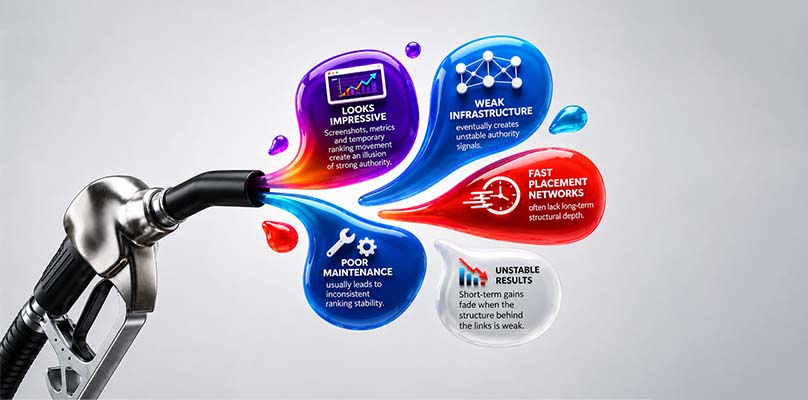
A PBN links service can still look impressive on the surface even when the underlying structure is weak. Screenshots, metrics, and temporary ranking movement may create the appearance of strong authority, but without proper infrastructure behind the network, that stability rarely lasts for long. The real strength of a backlink system usually comes from how well the entire structure is maintained over time, not just how powerful the placements appear initially.
- Weak infrastructure eventually creates unstable authority signals
- Fast placement networks often lack long-term structural depth
- Poor maintenance usually leads to inconsistent ranking stability
What Brand Theory Reveals About Permanent Homepage Backlinks
Most SEO strategies treat backlinks as technical ranking signals, but their influence often extends far beyond search visibility alone. When a brand is repeatedly connected to trusted websites and authoritative environments, it gradually starts feeling more established and recognizable in the minds of both users and search engines.
Search engines increasingly pay attention to how consistently a website appears across the web because repeated trust signals help reinforce credibility over time. That means backlinks are no longer just influencing rankings quietly in the background, they are also shaping the broader perception of the brand itself inside digital spaces.
Permanent homepage backlinks become especially powerful because they create long-term association between the brand and trusted environments. Over time, that consistency strengthens both authority and brand familiarity together, making the website feel more stable, visible, and naturally established within its niche.
How brand signals and link signals reinforce each other in ways most strategies never account for
When authoritative websites consistently reference the same homepage, both users and search engines naturally begin connecting that brand with stronger credibility and trust. At that point, the backlink starts functioning as more than just a ranking factor, it quietly becomes part of how the brand itself is perceived online.
Over time, this gradually strengthens:
- Brand recognition
- Consistent search trust
- Long-term visibility stability
And instead of working separately, these signals usually build on each other and grow stronger together over time.
Why permanent homepage backlinks on aligned domains strengthen brand identity inside search
Permanent homepage backlinks become much stronger when they come from websites closely connected to the same niche, audience, and topical direction. That alignment helps search engines understand the brand more clearly because the authority signals surrounding the homepage feel consistent and naturally connected rather than random or disconnected.
Instead of acting like isolated placements, the backlinks begin reinforcing a much clearer digital identity over time.
- Stronger consistency in brand positioning
- Higher topical trust within the niche
- Clearer authority recognition inside search results
That’s why aligned permanent homepage backlinks often contribute far more to long-term brand visibility than temporary placements that lack deeper relevance or structural connection.
What Network Theory Predicts About How PBN Links Compound
Authority rarely spreads across the internet in a completely random way. Search engines evaluate how websites connect to each other, how relevance flows between domains, and whether those relationships feel naturally structured over time. That’s why the strength of a backlink profile often depends not only on the individual links themselves, but also on how the surrounding network reinforces trust, relevance, and topical consistency together. In many cases, connected authority ecosystems compound much more effectively than isolated placements because the relationships between domains help strengthen the overall credibility of the entire structure.
Why relationships between linking domains matter as much as the links themselves
A backlink profile usually becomes much stronger when the websites surrounding those links reinforce the same niche direction naturally. Search engines do not only evaluate individual backlinks in isolation anymore, they also pay attention to how websites connect together and whether those relationships feel structurally consistent over time.
That’s why stronger authority networks often focus heavily on topical alignment, relevance flow, and natural connection patterns between domains. Isolated backlinks may still create movement temporarily, but connected trust ecosystems usually build much more stable authority because the entire structure supports the same overall direction together.
The Exit Problem Nobody Plans For
One of the biggest risks many businesses overlook is what happens when the backlink placements they rely on suddenly disappear. Weak infrastructure often creates authority profiles built around temporary systems that may not stay stable or maintained over the long term.
When those supporting links vanish unexpectedly, the impact on rankings can become much more aggressive because the authority structure underneath the site was never truly stable to begin with.
How permanent homepage backlinks built on stable infrastructure change this risk entirely
Permanent homepage backlinks built on stable and properly maintained infrastructure usually create much stronger long-term authority consistency. Instead of depending on short-lived ranking spikes, the website continues strengthening its visibility through placements that remain reliable and structurally supported over time.
That often leads to:
- More stable long-term rankings
- Stronger ongoing trust signals
- Less reliance on constantly replacing lost backlinks
And in highly competitive SEO environments, sustained stability often becomes far more valuable than temporary ranking gains that disappear quickly. This is ultimately what separates a reliable PBN links service from one that delivers short term movement but leaves nothing behind worth building on.

FAQs:
Why do PBN links continue working in modern SEO?
PBN links still influence rankings because search engines continue relying heavily on authority and trust signals to evaluate visibility.
What usually weakens a PBN network over time?
Weak infrastructure, poor maintenance, and repetitive footprint patterns often make networks unstable in the long run.
Why are permanent homepage backlinks considered valuable?
Permanent homepage backlinks help create stronger long-term authority, visibility consistency, and stable trust signals.
Can backlinks influence how a brand is perceived online?
Yes. Repeated visibility across trusted websites can gradually strengthen brand credibility and recognition over time.
What separates a strong pbn links service from a weak one?
A strong pbn links service usually focuses on topical relevance, structural stability, and long-term authority consistency instead of temporary ranking spikes.