

Most people enter SEO believing backlinks are simply a numbers game, where getting more links automatically leads to higher rankings. But after spending time understanding how search engines actually evaluate websites, it becomes clear that backlinks are judged through much deeper signals like relevance, authority consistency, content quality, trust patterns, and the overall environment surrounding the links themselves. A backlink can exist technically and still contribute very little if the surrounding ecosystem feels weak or disconnected.
That’s one reason to know what is Web 2.0 backlinks are and why they remain part of many SEO discussions today. For beginners especially, they offer a more controlled way to build contextual relevance and supporting authority around content instead of relying completely on random backlinks placed across unrelated websites. When used naturally, they can help create stronger supporting layers that make the broader backlink profile feel more balanced and structurally believable over time.
Why Most Beginners Get Backlinks Completely Wrong
A lot of beginners enter SEO thinking success comes from collecting as many backlinks as possible without fully understanding how authority actually behaves across search ecosystems. That approach usually leads to backlink profiles filled with weak or disconnected signals that may look impressive numerically but struggle to create stable ranking growth over time. Search engines now pay much closer attention to how naturally backlinks fit within broader relevance, trust, and visibility environments rather than simply counting how many links point toward a page.
The Common Mistake: Chasing Quantity Over Link Quality
One of the most common mistakes beginners make in SEO is believing that more backlinks automatically lead to stronger rankings. But in reality, a large number of weak or irrelevant links usually creates far less value than a smaller set of backlinks connected naturally to strong content and relevant authority environments. Search engines pay much closer attention to how trustworthy, relevant, and structurally consistent the overall backlink ecosystem feels rather than simply rewarding raw volume alone.
A stronger backlink profile usually benefits from:
- Relevant placements
- Consistent authority behaviour
- Supporting visibility signals
- Natural link diversity
That’s why experienced SEOs spend far more time building balanced authority ecosystems around their links instead of aggressively collecting backlinks without considering the quality and relevance surrounding them.
How Understanding Link Types Changes Your Entire SEO Strategy
Once beginners start understanding that every backlink type behaves differently, the way they approach SEO usually changes completely. A contextual editorial backlink, a Web 2.0 property, a niche citation, and a PBN backlinks for SEO all influence authority differently depending on how naturally they fit into the surrounding relevance ecosystem.
That shift matters because SEO becomes much more strategic when backlinks stop being viewed as simple numbers on a report. The real growth usually begins once you understand how different authority layers support, reinforce, and strengthen each other gradually over time instead of functioning independently.
What Is Web 2.0 Backlinks And Why They Still Matter in SEO
What is Web 2.0 backlinks usually refer to links created through user-generated publishing platforms where people can build blogs, articles, or supporting content pages that contain contextual links pointing toward their main website. Unlike random backlinks placed across unrelated pages, these platforms allow much more control over content relevance, structure, and the surrounding authority environment.
Even though SEO has changed significantly over the years, Web 2.0 links still remain useful in many strategies because they help create supporting content layers and additional visibility signals around primary authority sources.
That’s why many SEOs still use them as part of broader layered link-building ecosystems instead of relying only on direct backlink acquisition alone.

The Difference Between a Web 2.0 Site and a Regular Backlink Source
A Web 2.0 property gives much more control over the content environment because the creator can build and structure the supporting content directly instead of relying completely on third-party placements. That flexibility allows SEOs to strengthen contextual relevance and build supporting authority layers around target pages much more strategically over time.
- Better contextual alignment
- Supporting content layering
- Stronger topical reinforcement
- Flexible authority structuring
That’s one reason Web 2.0 properties still remain part of many modern layered SEO strategies, especially when the goal is creating more naturally reinforced authority ecosystems rather than depending only on isolated backlinks.
How Search Engines Evaluate Web 2.0 Links – What Actually Passes Authority
Search engines no longer judge Web 2.0 backlinks simply by checking whether a link exists on the page. They now evaluate how naturally the entire property behaves, including the relevance of the content, overall quality, activity patterns, and the environment surrounding the backlink itself.
A Web 2.0 page built only for dropping outbound links usually carries very little long-term authority value. Thin content, weak engagement, and disconnected relevance patterns often make the page feel artificial rather than naturally maintained.
Stronger Web 2.0 properties usually perform better because they are supported by useful content and a more believable visibility ecosystem. Search engines pay attention to crawl behaviour, content consistency, engagement signals, and how naturally the authority structure connects together over time. That’s why well-structured supporting content often passes far more meaningful authority than isolated backlink pages created only for SEO purposes.
Popular Web 2.0 Platforms That SEOs Actually Use (With Examples)
Many SEOs still use Web 2.0 platforms because they offer flexible publishing environments where supporting content and contextual backlinks can be built around primary websites more naturally. But over time, most experienced marketers realize the platform itself matters far less than how well the content ecosystem is maintained and connected to the broader authority strategy.
Common platforms often include:
- Medium
- Tumblr
- WordPress.com
- Blogger
- Weebly
The real effectiveness usually comes from content quality, relevance consistency, and how naturally the supporting ecosystem behaves over time rather than simply creating the Web 2.0 property itself.
Web 2.0 vs PBN Backlinks – Which One Should You Be Using?
Web 2.0 backlinks and PBN backlinks for SEO are often grouped together in SEO discussions, but they usually serve very different roles inside a backlink strategy. Web 2.0 properties are commonly used to build supporting relevance, contextual content layers, and broader visibility ecosystems, while PBN links are typically used for stronger authority reinforcement in more competitive search environments where ranking pressure is much higher. The better option usually depends on the competition level of the niche, how difficult the keywords are, and how aggressively the authority surrounding a website needs to grow.
What Makes PBN Backlinks Different From Standard Web 2.0 Properties
PBN backlinks are different from standard Web 2.0 properties because the domains used in PBN networks often already carry historical authority, aged trust signals, and existing backlink strength before any new content is even published on them. That existing authority is one reason PBN links can sometimes influence rankings much faster compared to newly created Web 2.0 pages that start with very little trust or visibility initially.
Web 2.0 links usually focus more on building supporting relevance, content layering, contextual diversity, and secondary authority reinforcement around a website, while PBN backlinks are generally used more directly for stronger authority transfer and faster ranking reinforcement in competitive search environments.
When Web 2.0 Links Are Enough and When You Need PBN Power
Web 2.0 links are often enough when the goal is building supporting relevance, strengthening content ecosystems, and improving visibility around lower to medium competition keywords. They usually work well in strategies where gradual authority growth, contextual reinforcement, and natural ecosystem development matter more than pushing aggressive ranking movements quickly.
But highly competitive niches sometimes require:
Stronger authority acceleration:
When competitors already have heavily established backlink ecosystems and organic growth alone moves too slowly
Faster discoverability:
When ranking speed directly affects traffic opportunities, audience attention, or lead generation
Higher trust reinforcement:
When search engines expect stronger authority signals before allowing visibility movement in difficult niches
Greater ranking pressure support:
When competitive keywords require deeper authority strength to compete against dominant sites already controlling the SERPs
That’s usually where PBN power becomes part of the conversation, especially in industries where slower authority growth struggles to compete against already established websites with aggressive backlink profiles and stronger historical trust signals.
How to Find the Best PBN Backlinks for Sale
One of the biggest problems beginners face is that many weak PBN sellers know how to make their networks look impressive on the surface. High metrics, polished screenshots, and fast ranking promises often hide structural weaknesses that are not immediately visible during the buying process.
A network can appear powerful initially while still carrying unstable authority behaviour underneath over time. Weak infrastructure, repetitive site patterns, poor relevance consistency, and low-quality content environments usually become much more noticeable later once rankings begin fluctuating or authority starts weakening. That’s why relying only on metrics without understanding the broader ecosystem often leads many buyers toward unstable backlink strategies.
That’s exactly why experienced SEOs usually evaluate ecosystem quality and long-term structural stability far more carefully than screenshots or temporary authority numbers alone when searching for the best PBN backlinks for sale.
Red Flags That Signal a Low-Quality or Spammy PBN Seller
Low-quality PBN sellers usually reveal themselves through repetitive patterns that feel overly engineered once you look beyond the surface-level metrics. Things like identical site designs, thin AI-generated content, unrealistically cheap pricing, aggressive outbound links, and repeated hosting footprints often signal weak infrastructure underneath. Even if the rankings look good initially, those unstable patterns usually create authority problems much faster over time.
Realistic Pricing Expectations – What Quality PBN Links Actually Cost
Quality PBN links are rarely very cheap because maintaining stable infrastructure, proper hosting separation, content consistency, and lower network footprints requires continuous investment.
Pricing often increases based on:
- Niche competition
- Domain authority quality
- Content maintenance
- Structural separation
- Long-term stability
That’s why extremely cheap PBN offers often become a strong sign of weak ecosystem quality and unstable authority behaviour underneath.
PBN Gambling Links – Why the iGaming Niche Plays by Different Rules
The gambling industry operates under much heavier competition and algorithmic scrutiny compared to most other niches online. In casino SEO, almost every major competitor is already investing aggressively into authority building, which means weaker backlink strategies usually struggle to create meaningful ranking movements.
That pressure changes how backlinks behave inside the niche because search engines tend to evaluate gambling-related authority patterns much more strictly. As a result, stronger relevance, trust consistency, and deeper authority reinforcement often become far more important in iGaming SEO than in lower-competition industries. This is exactly why PBN gambling links require a more thoughtful approach than standard backlink placements.
What a Compliant and Effective PBN Gambling Link Profile Looks Like
A strong gambling backlink profile usually feels balanced, naturally aligned to the niche, and structurally believable instead of looking aggressively built only for rankings. More stable casino SEO strategies often combine different authority layers together rather than depending too heavily on one concentrated backlink source alone.
More stable structures usually prioritize:
- Topical consistency
- Supporting relevance layers
- Controlled outbound behaviour
- Natural authority diversity
- Stable crawl patterns
Because in casino SEO, weak authority behaviour and unnatural backlink patterns usually become noticeable much faster under heavy algorithmic scrutiny.
Building a Safe and Scalable Link Strategy Using Web 2.0 and PBNs Together
The safest SEO strategies today usually rely on multiple authority layers working together instead of depending too heavily on a single backlink source. Web 2.0 properties and PBN backlinks for SEO often perform much better when they support each other naturally within a broader content and relevance ecosystem rather than functioning as isolated authority signals.
That kind of layered structure usually creates stronger long-term stability because the authority flow feels more balanced, contextual, and naturally reinforced over time.
How to Layer Web 2.0 Properties Around PBN Links to Avoid Footprints
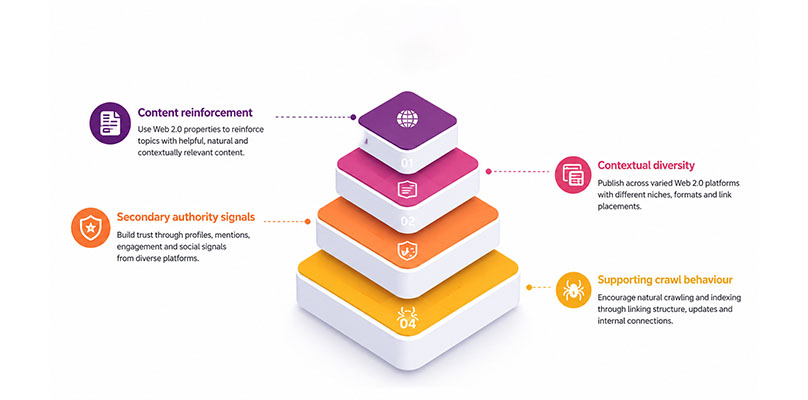
Web 2.0 properties often help reduce how isolated PBN authority appears by adding extra contextual relevance and supporting visibility around the broader backlink ecosystem.
Supporting layers usually help through:
- Content reinforcement
- Contextual diversity
- Secondary authority signals
- Supporting crawl behaviour
That surrounding ecosystem usually helps the overall backlink profile feel more balanced, naturally reinforced, and structurally believable over time.
FAQs:
- What makes Web 2.0 backlinks different from regular backlinks?
Web 2.0 backlinks allow more control over content relevance and supporting authority structure.
- Why do many beginners fail with backlink building?
Most beginners focus on backlink quantity instead of relevance, trust, and ecosystem quality.
- Are Web 2.0 links still useful in modern SEO?
Yes, they still help build contextual relevance and supporting visibility signals naturally.
- When are PBN backlinks stronger than Web 2.0 links?
PBN backlinks are usually stronger in highly competitive niches requiring faster authority growth.
- What should you avoid when buying PBN backlinks?
Avoid networks with repetitive structures, thin content, and unrealistic ranking promises.