
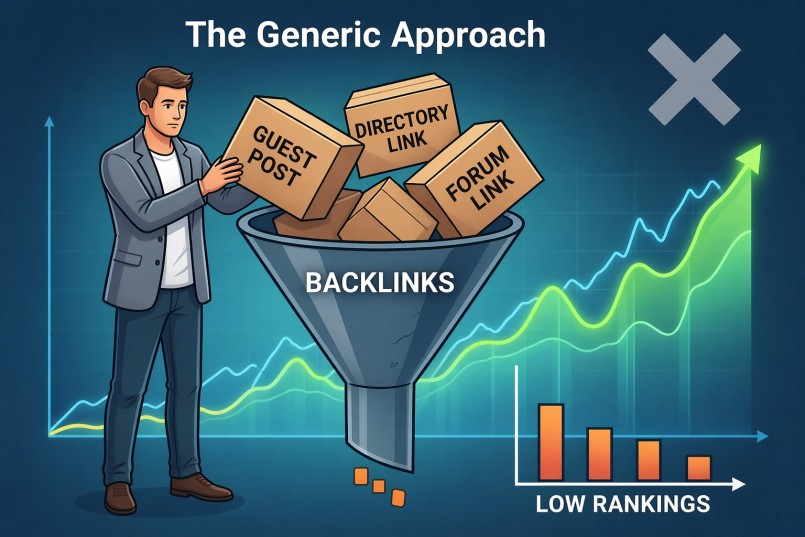
If you have been investing time and money into SEO, but your competitors are still ranking higher than you it is really frustrating. The problem is not that you are not trying hard enough, it is that you are in the wrong direction. In highly competitive search results, using generic link-building strategies doesn’t just give weak results, it can actually slow your progress. The difference between simply appearing in rankings and truly standing out usually comes down to the quality of your links, how relevant they are to your niche, and how strategically they’re implemented.
What many site owners miss is that modern SEO isn’t about doing more, it’s about doing the right things consistently and with clarity. You can keep publishing content and building links, but still see no real progress if those efforts aren’t aligned. If your signals to Google aren’t clear, consistent, or lack relevance, they don’t add up to strong authority. It’s not about the volume of work that drives results, it’s how focused and aligned your efforts are over time.
This isn’t just a basic overview of PBNs. It takes a closer look at where most SEO strategies tend to fall short, how niche PBN backlinks actually work in competitive spaces, and how to approach them without triggering risk signals.
Generic Links Don’t Win Competitive Rankings
Backlinks might seem like a numbers game at first. You think that the more backlinks you have the better you will rank.. This idea does not work for long in crowded markets.
When you are working in an industry where your competitors are already investing a lot in SEO, backlinks are not good enough. I mean links from guest posts on blogs that’re not related to your topic or from directories. If you’re looking to buy niche backlinks, this is exactly the gap they’re meant to fill content and niche relevance, not just volume.
In general, Google looks at more than just the number of backlinks you have. Let have an algorithm check
- How closely the linking page aligns with the topic of your target page
- The level of authority your site has within a specific subject area
- How consistently relevant your overall backlink profile is
If your competitors are getting backlinks from websites that are closely related to their niche and your links are more general, you’re essentially sending weaker signals. Over time, this creates a situation where your site looks active, you’re building links but not truly authoritative in any one area.
Over time, this leads to a lack of clear authority, your site may seem active, but not strongly focused on any one topic. That’s often why rankings stop progressing and level out.
The authority gap in niche markets
This is where many websites fall behind without even noticing it. You might be building more backlinks, but a competitor with fewer links can still outrank you, and it often comes down to how focused their links are.
For example, they may be doing a few key things better:
- Their links come from websites within the same niche
- Their anchor text naturally matches the niche they’re targeting
- Their referring domains consistently support their Strengthen
On the other hand, if your links are more generic or spread across unrelated sites, then there is less impact.
Over time, this gap becomes more noticeable. As competitors build strong, niche relevant backlinks, each new link strengthens their position further. Meanwhile, your efforts may not create the same momentum, which is why progress can feel slow or stagnant.
What Google actually rewards now
Today, Google isn’t just looking at how “big” or authoritative a site is overall, it cares more about how clearly your site is connected to a specific topic. In simple terms, being highly relevant within your niche matters more than having broad, general authority.
What that means in practice is:
- A link from a smaller, niche-focused blog can often carry more weight than one from a high-authority site that isn’t closely related to your topic
- Where your link appears matters links placed naturally within relevant content are more valuable than generic homepage placements
- Relevance builds over time the more consistently your links align with your niche, the stronger the impact
More importantly, Google looks for consistency. If your backlinks keep reinforcing the same topic and context, it becomes much easier for Google to understand what your site is about. And when that clarity is there, ranking becomes much more achievable.
What Makes a PBN “Niche” and Why That Distinction Is Everything
Not all PBNs are the same, and this is where a lot of people misunderstand how they actually work.
A niche PBN isn’t just a random group of websites used for backlinks. It’s more like a carefully built network of sites that all focus on a specific niche. The idea is to create an environment where your links naturally fit, so they pass stronger, more relevant signals.
So instead of thinking of it as “just buying links,” it’s better to see it as having control over the context your links appear in. And that context is what makes a real difference because it lets you shape relevance in a way that typical outreach links often can’t.
Topical relevance vs. domain authority
A lot of traditional SEO advice focuses heavily on metrics like domain authority (DA/DR). But practically speaking, relevance usually matters more.
For example:
- A website with DR=30 that’s closely related to your niche can be more valuable than a website with DR=70 that has nothing to do with your niche.
- Links placed naturally within content tend to perform better than links stuck in sidebars or footers.
- When a link is relevant, the value it passes becomes stronger and more meaningful
Niche PBN backlinks actually works because:
- The content is built around your target keywords.
- Internal links across the network reinforce the same subject areas.
- Links are placed in a way that feels natural and editorial, rather than forced.
What often gets overlooked is that relevance doesn’t just pass authority, it actually makes it easier for Google to understand what your website is about.
How niche relevance builds trust signals
Google doesn’t “trust” individual links in isolation, it looks at patterns across your entire backlink profile.
When your backlinks:
- Come from websites within similar industries
- Use language that’s closely related to your niche
- Appear inside content that makes contextual sense
That’s when they start to form a consistent and believable signal.
Over time, this builds momentum. As your rankings improve, you gain more visibility, which leads to more organic engagement and traffic to your website, further strengthening your authority. Niche PBNs are often used to kickstart this process, especially when a site hasn’t yet gained much organic traction.
Bad Execution Is the Real Risk, Not PBNs
Let’s address the obvious concern which is risk.
PBNs have a bad reputation, but not necessarily because the idea itself is flawed. Most of the issues come from how they’re executed. When done poorly, they leave clear patterns that search engines can easily pick up on.
And to be fair, this isn’t limited to PBNs. Even poorly handled “white-hat” link building can hurt your website. The difference is that PBN mistakes tend to stand out more when there’s no effort to avoid patterns.
Footprint mistakes that expose your website
Most penalties don’t happen just because someone used a PBN, they happen because the setup leaves obvious footprints.
Common mistakes include:
- Using the same hosting or IP ranges across multiple sites
- Repeating the same themes, plugins, or website layouts
- Overusing the same anchor text again and again
- Publishing thin, low-quality, or duplicated content
When everything starts to look the same, it becomes easy for search engines to connect the dots. A well-built network does the opposite, it avoids uniformity and behaves more like a group of independent, naturally run websites rather than something controlled.
Signs your current provider may be cutting corners
If you’re already using PBN links but not seeing stable results, the issue is usually the quality, not the concept itself.
Some warning signs might look like:
- Rankings spike quickly and then drop just as fast
- Links appear on pages that have no real relevance to your topic
- There’s little to no transparency about the websites being used
- The same anchor text is reused across different placements
When results feel inconsistent, it’s often a sign that the link quality isn’t stable or reliable. In the end, PBNs aren’t inherently risky, it’s the execution that determines whether they help or harm.
Fitting PBNs Into a Clean Link Profile
One of the most common mistakes people make is treating PBNs as the entire strategy. That’s usually where things start to go wrong. In reality, PBNs are just one piece of the puzzle, not the whole picture. The real strength comes from how well they’re combined with other types of links, not from using them in isolation.
A healthy backlink profile is usually a mix of different sources. This might include:
- Naturally earned or editorial links
- Guest posts on relevant sites
- Niche PBN links
- Brand mentions and citations
When your links come from a variety of places, your profile starts to look more natural. It also becomes more stable, because you’re not relying on just one method that could easily be flagged or lose effectiveness.
Why balance matters
Blending PBN links with more traditional, white-hat links creates a more believable pattern.
Here’s why that works:
- It avoids obvious patterns that can be detected
- It reflects how links are naturally built over time
- It spreads out anchor text more organically instead of repeating the same phrases
Instead of everything looking controlled or intentional, your backlink profile starts to resemble how real websites grow, gradually and from different directions.
A balanced approach often follows a rough structure like this:
- Around 50-60% from white-hat sources like guest posts, PR, or citations
- Around 20-30% from niche PBN links
- The rest from branded or low-risk links
This doesn’t have to be exact, but it gives you a framework to avoid over-relying on any one type. The goal isn’t to make your link building invisible, it is to make it believable.
When your backlink profile reflects a mix of sources, consistent relevance, and natural variation, it aligns much more closely with how genuine websites earn links. And that’s what ultimately makes the strategy more sustainable and effective over time.
Industries Where Niche PBNs Tend to Work Faster
Not every industry responds to link building in the same way. In less competitive niches, even a handful of decent backlinks can make a noticeable difference. But once you move into more competitive spaces, the gameplan changes completely. It is no longer about just building links, it’s about how precise, authoritative and relevant those links are.
This is where niche PBNs tend to show clearer results, especially in industries where rankings are harder to move and authority plays a bigger role.
Where they tend to perform best
Sectors like finance, legal, healthcare, and local services are typically more sensitive to link quality and relevance. These industries share a few common traits:
- Competition is intense, with many sites actively investing in SEO
- Search results are heavily driven by authority and trust signals
- There’s already a large volume of content covering similar topics
Because of this, generic links don’t really make much impact. You can build them, but they often don’t move rankings in any meaningful way.
What starts to matter more is content relevance, how closely your backlinks match your niche and strengthen your website authority. In these industries, Google tends to favor sites that show consistent, focused authority rather than scattered signals.
There is also an added layer of evaluation. Especially in areas like finance and health, content and links are evaluated more carefully. So it’s not just about ranking, it’s about building credibility to your website. When you buy niche backlinks from well-built, relevant networks, your backlinks support that credibility rather than weaken it.
What kind of timelines you should expect
One reason niche PBNs are often used in these spaces is because they can create more noticeable movement compared to generic link building. But that doesn’t mean results are instant, it still depends on the level of competition.
A rough idea of how things usually play out:
Local SEO:
You might actually start seeing movement within 2-6 weeks
Medium competition niches:
Typically around 4-10 weeks
High competition niches:
It can take anywhere from 8-16 weeks
These timelines aren’t fixed, but they give a realistic expectation of how long it takes for link signals to settle and reflect in rankings.
What actually matters during this time period
It’s easy to focus on quick wins, sudden ranking jumps or short-term spikes. But those aren’t always reliable indicators of progress.
What you really want to watch is consistency:
- Are rankings gradually improving over time?
- Are positions stabilizing instead of fluctuating rapidly?
- Is visibility increasing across multiple keywords, not just one?
When growth is steady and sustained, it usually means that your links are being integrated properly and your authority is gradually building in the right direction. But here is this thing, In competitive industries, link building isn’t about volume anymore, it’s about precision, consistency, and relevance.
Niche PBNs can help accelerate that process, but only when they’re used as part of a structured approach. When your links consistently strengthen the same niche and authority signals, that’s when you start seeing meaningful, lasting improvements in rankings.